
Nobody knows what the next major catastrophe will be, so there’s little point spending a lot of time pondering over exactly what will happen. Especially when the survival solution is always the same – be somewhere else. But here are some scenarios to consider the consequences of:
Comet / Asteroid
There are two very different outcomes from an asteroid or comet colliding with our planet – a land strike or a sea strike. If it lands in the ocean, expect a mother of all tsunamis to destroy every coastline within its reach, and numerous miles inland. The tsunami could potentially be hundreds of metres in height. The good news is that once the seas have subsided, it’s all over bar cleaning up and starting again.
If it strikes solid ground, then multiple scenarios become intertwined. An asteroid striking the ground will (depending on the approach angle) possibly disintegrate into thousands of pieces, each being relaunched into the atmosphere and then falling back down to Earth aflame. Whether it breaks up or not, the amount of dust and dirt flung into the air could cool the planet for many years.
If it does break up, then fires could be widespread and long-lasting. If this sounds Biblical, then perhaps it has happened before…
NB. In the unlikely event that news reports tell you the asteroid or comet is aimed right at your survival spot, and if you are fortunate to live on a continent – hit the road! It would be good to have in the back of your mind an alternate safe spot that you can get to by land, and a quiet route for getting there.
Tsunami
The good news is there’s no such thing as a spontaneous tsunami. It has to be triggered by another event, by a geophysical disruption. Most likely candidates are earthquakes, asteroids/comets and landslides. Whether you get a warning or not is a factor of your proximity to the epicentre, and the availability of a local warning system.
Despite the great loss of life, the two major tsunamis of recent times are actually quite small compared to the biggest of all time, and what is physically possible. If you wish to prepare for the very worst, think of tsunamis hundreds of meters in height. Wikipedia lists the highest recorded mega-tsunamis of the last 500 years:
1792: Mount Unzen, Japan, 100 meters
1958: Lituya Bay, Alaska, USA, 524 meters (caused by a landslide)
1963: Vajont Dam, Italy, 250 meters (landslide above a dam)
1980: Spirit Lake, Washington, USA, 260 meters (Mt St Helens landslide)
An asteroid can crash anywhere, but at least we have some suspects for where the next tsunami causing landslide will be:
Cumbre Vieja volcano, Canary Islands. This volcano is dormant, but if and when it erupts again, the result could be a landslide, which in turn would create a tsunami one kilometre in height. By the time it reaches the East Coast of the USA and the Caribbean, it would still be 50 meters high and millions of people could die.
Mauna Loa volcano, Hawaii. Likewise, an eruption & landslide could cause a 1 kilometer high tsunami, and this actually happened 12,000 years ago. This time around, Honolulu would be wiped out just 30 minutes later.
Earthquake
Earthquakes happen all the time, and so far we have been unable to predict them. Many of the scenarios listed here could be accompanied by an earthquake – volcano, tsunami, asteroid/meteor, pole shift… So expecting an earthquake should be a key consideration when choosing a location and creating a safe spot.
Keep away from known fault lines. Don’t be at the bottom of a slope. Don’t be in cave, or house, or any structure that is not suitably reinforced. Don’t have anything that can collapse above your bunker entrance. Within your bunker/basement/room make sure that things are secured.
A major earthquake in your area is good prompt to relocate. In less than a year since Christchurch’s deadly earthquake, 20% of their citizens have moved away. They aren’t survivalists, they’re just using their gut instinct.
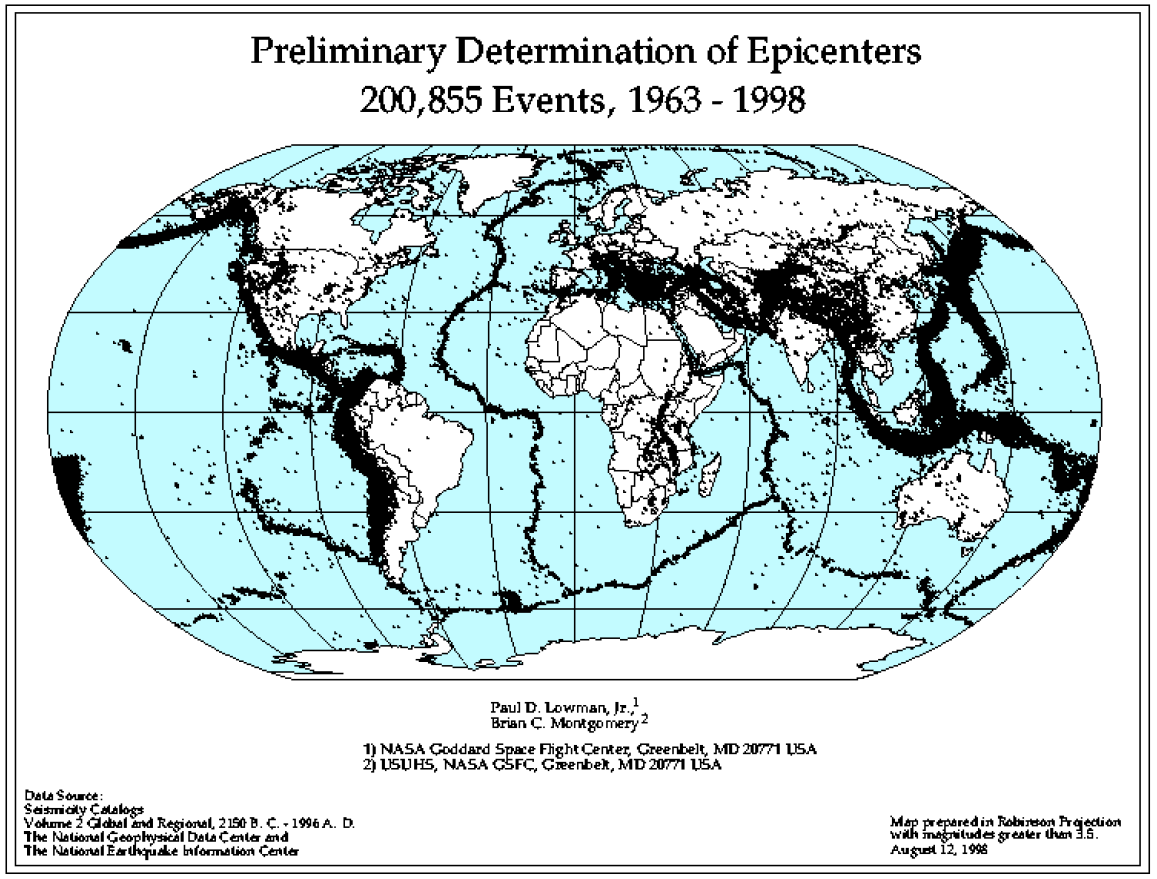
A very sobering map from NASA (below) shows all earthquake epicentres greater than Richter 3.5, 1963-1998. The places to avoid stand out a mile.
Nuclear
In theory, a terrorist’s dirty bomb could be used anywhere. And pretty much any city in the northern hemisphere could be hit by a nuclear missile. Nuclear power plants have a fixed location, so at least you can choose to avoid them.
FEMA describe two zones of safety in the case of a nuclear accident. Basically you want to be more than 10 miles away at the time of the accident, and you want to live more than 50 miles away afterwards. These are rough guides, and really depend on the speed and direction of the wind. I suggest a minimum of 100 miles between your safe spot and any potential nuclear disaster.
As we saw in 2011, a tsunami can lead to the meltdown of a nuclear power plant. Any event that damages the plant, or shuts off their electrical supply, can lead to meltdown. That list would include earthquakes, deliberate sabotage or terrorist attacks, loss of the power grid due to a CME, floods or tornadoes.
Volcano
A supervolcano would immediately wipe out surrounding populations, and ultimately place the human species in danger of extinction. If you are lucky, precursor tremors will alert you to the possible situation.
A smaller volcano will not endanger us to the same extent, but if it occurs in a key country of the global economy, the flow-on effect could be huge. As I write this, the volcanoes of Iceland seem poised to disrupt European air travel for extended periods of time. This will affect tourism, but also business travel, and more significantly, air freight. The butterfly effect of something as basic as parcel delivery taking weeks instead of days has probably not been modelled, although I suspect it could cause a global recession.
Cosmic Radiation
This is a long-shot. While a mass influx of cosmic rays could explain mass extinctions, ancient climate change or even evolution, it’s all just speculation. The problem is, we don’t really know enough about where cosmic rays come from, and a lot of knowledge about outer space is based on assumptions.
Scientists assure us that there are no stars capable of going supernova in the near future, which are also near enough to harm us. Yet, just when they thought they had every type of star catalogued, they find something new. There are several nearby stars that are about ready to explode, and it wouldn’t take much for the experts to be wrong about how safe we are.
Eta Carinae is about to explode (and looks it as well) and one scientist believe it could completely destroy our ozone layer.
The bottom line, the best place to be for safety from cosmic rays is under lead shielding, under a lot of concrete (a pyramid would do the trick), or underground.
Coronal Mass Ejection
A CME is a massive burst of energy from the Sun. It is often, but not always, associated with a solar flare. CMEs occur several times per day during the peak of the solar cycle, but because we are tiny compared to the Sun, we are rarely in their path. The last major one, in 2012, missed us. If it had been on target, we could have really suffered
When we are in the path of a CME, great harm can be inflicted upon us, especially now because of our reliance on electronics. If you stand outside during a CME that is directed towards Earth, you won’t notice anything different. It won’t be any warmer and you won’t get sunburnt. Pretty much the only problem will be the harm done to electronics.
Depending on the intensity, the most likely result is no harm done. The next most likely is the damage to, and/or loss of a satellite. Or a few satellites. If it is any stronger it can take out transformers here on Earth, and beyond that an entire power grid could go down. The grids of Europe and the USA, due to their age, are especially susceptible.
A NASA report, Severe Space Weather Events — Understanding Societal and Economic Impacts, summed up how serious a risk CMEs are for the USA:
…more than 350 transformers at risk of permanent damage and 130 million people without power. The loss of electricity would ripple across the social infrastructure with “water distribution affected within several hours; perishable foods and medications lost in 12-24 hours; loss of heating/air conditioning, sewage disposal, phone service, fuel re-supply and so on.”
Even if it is only satellites affected, serious chaos could result. The loss of GPS satellites would affect much more than just your Garmin or TomTom. Actually 90% of GPS receivers use the data for timing not location. If GPS signals are lost, these are some of the services that will be affected:
Cell phone towers
Air traffic control
Emergency pagers
ATM machines
Electric grids
Stock exchanges
…and navigation (obviously), but not just your car – think freight in a just-in-time environment, emergency services, shipping and train routing.
The first four of the above services were affected in San Diego for 2 hours in January 2007. The culprit was later discovered to be a naval exercise nearby, where they blocked radio signals.
A CME Scenario
Imagine this. Your electricity is switched off, without warning. You check with your neighbours, and it looks like your whole street has been affected. Oh well, it’s Saturday night, so you get out some flashlights and play charades with your family. At bedtime you go to fetch a glass of water and realise that water is off as well. Somebody will fix these things you think as you drift off to sleep.
The next morning there’s still no electricity or water. And you’ve just realised that your landline and cell phone aren’t working either. You are discussing it with your neighbour when you notice somebody reversing out of their driveway, the station wagon packed to the brim, as well as the roof rack. Turns out they heard a radio news report that said it could take weeks for services to be up and running again, so they are heading to a friend’s farm.
With no farm to go to, you decide you better stock up on some supplies, but it is too late. Everywhere is closed. Supermarkets, gas stations, shopping malls, restaurants. ATMs aren’t working. Many premises are guarded by their owners, brandishing rifles. Some businesses, especially supermarkets, have already been ransacked.
No food, no water, no money. No heating or cooling. No way of calling for help. And when the government says weeks, the reality is that it could be almost a year before everything is back to normal.
And then you hear a rumour that a nearby nuclear facility is in meltdown…
Magnetic Pole Shift
Science has not yet determined the mechanism of a magnetic pole shift, but by studying the magnetism of ancient rocks they can tell that shifts have occurred many times in the past. The magnetic north pole is rapidly moving across Canada. The strength of our planet’s magnetic field is rapidly diminishing. While we do not know if these factors are relevant or not, it makes sense to prepare for the worst.
A flip of the magnetic poles would primarily affect navigation – anything that uses a compass, and those birds and animals that are tuned in biologically. Basically, pigeons get lost and planes crash.
If the flip coincides with a lack of magnetic field, then we could suffer terribly for the duration of the flip. The electromagnetic field keeps our planet safe from harmful radiation from our Sun and from space. Without that shield, crops, animals and people who are not undercover will burn, or suffer from mutations.
According to orthodox science, a pole shift would take hundreds or thousands of years. The fatal flaw is that, if historical shifts had happened overnight, science would not be able to detect such a rapid change. To do so would require the ability to tell that one rock is one day older, after thousands or millions of years, than another. The notion that it will take a thousand years is a derivative of the resolution of the data available to them.
It could happen while you are sleeping. It is presumed that sudden and unusual weather would be an indicator – if a news service hadn’t already told you.
Crustal Pole Shift
This concept is not accepted by orthodox science, although it has had some distinguished fans, including Albert Einstein. While there is evidence for displacements in relatively recent geological times, the sticking point is a lack of internal mechanism.
With a displacement, the Earth’s outer crust moves rapidly (as opposed to the extremely slow movement due to plate tectonics) and slips relative to the core. The result is that land masses end up being located at a different latitude/longitude than before the shift. A famous piece of evidence for such a shift is the graveyard of mammoths in Siberia. The mammoths were snap frozen. One specimen was chewing on a plant when he died – a plant that does not live in arctic zones. The supposition is that the mammoths were living in a more temperate region, and a sudden pole shift transported them to the Arctic.
According to Charles Hapgood, the shifts were roughly 30-40 degrees in nature, and the last one occurred approximately 12,000 years ago.
A crustal displacement is featured in the blockbuster movie 2012.
Civil Unrest
This is vastly under-appreciated, and past instances – in Western societies – are conveniently forgotten. In Europe, the USA and Australia riots have been shorter-lived and less impactful than in other lands, such as in the Middle East in 2011. That comes down to motivation. While both are generally triggered by a small (but not trivial) incident such as self-immolation or a death in custody, those in the west have not generally sought a change in power. If a government is seen to be inept during a catastrophe, causing people to suffer, they can and will fight back in any society.
Unless you are someone wanting to cause unrest, the safest place for you and your family will be somewhere else.
Military Invasion
Large, stable democracies (and their allies) are unlikely to suffer a military invasion, in normal times. However, in conjunction with some of the other events listed, it is a possibility. For example, a volcano could devastate a country, leaving it vulnerable to an attack from a neighbour.
Terrorism
We are fortunate that terrorists tend to prefer explosions, and have mostly ignored attacking infrastructure. If someone really wanted to, and had the right skills, they could, conceivably:
Hack into a nuclear power plant and cause meltdown
Hack into the power grid and cause it to fail
Contaminate water supplies
Interrupt GPS reception
Shut down ATMs
Cause stock market chaos
Remember, don’t just think of these as isolated possibilities. Several facilities could be attacked at once, or they could choose to strike during a natural disaster.
Global Warming / Climate Change
It is my considered opinion that Anthropogenic (man-made) Global Warming is negligible and not worth worrying about. Temperatures were rising until the end of last century, but the links between temperature changes and human activity are poor. I wouldn’t be surprised if we are heading towards a cold spell, especially if the next solar peak (maybe 2025) is as weak as some predict.
I believe climate change is very real and probably driven by our Sun. The activities of our Sun are notoriously difficult to predict, and that gives us an additional reason to be prepared. If temperatures were to quickly rise or drop by a few degrees, then the effects on crops will be considerable. This would most likely trigger food-shortages, which could then trigger civil unrest. You might want to be in your safe spot, with your supplies, until things calm down.
If temperatures start to rise again, our weather will become less stable. This is where the butterfly effect comes in to play. Most people in the US west have noticed the increased number of hurricanes each year. That’s only the beginning. Floods are also increasing. And there is concern that next up could be a destabilization of the North Atlantic Current…
Before the 2012 movie, Roland Emmerich made The Day After Tomorrow, a disaster flick which showed the effects of a rapid-onset ice age. Most people are unaware that the film is based on a non-fiction book, The Coming Global Superstorm, in which global warming causes enough of the ice caps to melt that the salinity in the Atlantic lessens, leading to changes in the Gulf Stream and North Atlantic Current. The end result is an instant ice age.
Mini Ice Age
Just like the movie helmed by 2012 director, The Day After Tomorrow, our planet’s climate is capable of rapid change, according to scientists from the University of Saskatchewan.
Around 12,800 years ago the northern hemisphere was hit by the Younger Dryas mini ice age or “Big Freeze…and lasted around 1300 years.
Until now, it was thought that the mini ice age took a decade or so to take hold, on the evidence provided by Greenland ice cores.
…The group studied a mud core from an ancient lake, Lough Monreagh, in western Ireland. Using a scalpel they sliced off layers 0.5 to 1 millimetre thick, each representing up to three months of time. No other measurements from the period have approached this level of detail.
…They show that at the start of the Big Freeze, temperatures plummeted and lake productivity stopped within months, or a year at most. “It would be like taking Ireland today and moving it up to Svalbard” in the Arctic, says Patterson.
The drop in temperatures averaged 5 degrees globally, but as much as 15 degrees in Greenland. The date of the mini ice age, and the rapid onset, suggest a global cataclysm caused by a pole shift or asteroid/comet. Numerous books have been recently hypothesising either scenario, and this recent evidence makes their ideas even more compelling.
Not only would normal activities and crops be under pressure, a universal lack of preparation would compound the problems. For example, massive increases in energy use to keep people warm, as well as shortages of heating equipment. Sea passages would close, planes would be grounded, and trains wouldn’t run. Pipes will burst. And on top of it all, people will be scared and confused, untrusting of scientists. Many will be seeking to move south, too many at once.
Water Shortage
There are two ways that water might become an issue. The first is that water is available, but becomes very expensive due to more people wanting to access dwindling supplies. The second is where supplies become contaminated – something terrorists can easily achieve, or it could be the result of a natural event, like volcanic ash in water reservoirs.
To cover all eventualities, it would be prudent to maintain a large supply of stored water, as well as making sure your safe spot has its own water supplies. Typically this would be via a bore or well (easy to keep ash out), a lake or river, or by collecting rainwater.
Food Shortage
This could be a result of many of the scenarios listed here, or it can happen on its own, via over-population or crop disease, or war. The simple answer is to have lots of food supplies in storage, and to purchase them prior to the general public deciding to do the same. You will also need to consider that you will own a valuable commodity in what could be a fragile and dangerous community. Therefore it is critical that you do not tell anyone about the extent of your supplies, ever. It is the sort of thing that people will recall after a catastrophe, that so-and-so has 10 giant bags of rice. Friends will pressure you to share (share by all means, but for it to be on your terms means keeping quiet about it beforehand), and others may be tempted to steal from you – desperate measures for desperate times.
It is also critical that you don’t keep all your supplies in one place, and they are well hidden. Under a blanket in your garage is not good, in the attic is better, and buried somewhere is really good.
Plan on Being Wrong
It saddens me to see so many people who are certain X will occur, and have based their survival plans around their own dead-set ideas. I’ve been telling people until I am blue in the face – nobody knows what will happen! It is quite likely that the event is something nobody thought of.
Don’t become too obsessed with your own ideas, or those of someone else because they seemed genuine in a YouTube video, or their book has an authoritative tone. So swallow your pride and prepare for all the things you doubt will happen.