South Africa
I do not suggest that anyone moves to South Africa for survival purposes, unless they know the place well. The following opinions are only for those who already live there.
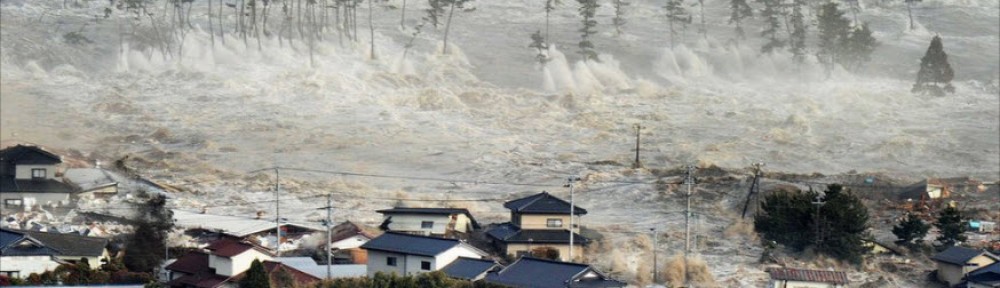
The major cities (except for Johannesburg) are coastal. Tsunamis are not really a risk for South Africa – a study conducted after the devastating Asian tsunami of 2004, by a Japanese research group, concludes:
“The probability of a major tsunami devastating the South Africa coast is very low. However, the consequence of the impact could be catastrophic.”
A list of historical tsunamis at Wikipedia does not mention any part of Africa ever being affected, and while that does not mean there has not been any, it seems a whole lot safer than Asia or the Pacific.
Johannesburg is the largest city in the world that is not alongside the coast, a lake or a river. It is also situated 1750m above sea level. While it is safe from flooding, it does have 10 million people and a high existing crime rate. For those reasons alone, this is not somewhere you should choose to be when the SHTF.
Cape Town is (according to some online commentators) the safest major city crime wise, but a big negative is the nearby nuclear power plant, the only one in South Africa. Interestingly, the nation did have a nuclear weapons program, but that was terminated in the early 90s and all weapons were dismantled.
The Drakensberg (literally “Dragon mountains” in Dutch) have long been championed by Patrick Geryl, and their mention at the end of the 2012 movie highlights popularity of the idea of surviving there. The mountains have a lot of good features, such as height (up to 3400 metres) and rainfall. Below the tree line (2500m) you can find grassland, woodland and forest. Further down there is an abundance of wildlife, including antelopes, wildebeest and rare white rhinos.
The mountains include parts of Swaziland and Lesotho, places that I think would need to be visited to determine their appropriateness. Geryl has kept secret the precise location of his survival spot, but I’d be looking at the tourist area of Central Drakensberg, around Champagne Valley. Specifically Winterton. South African survivalists should consider visiting this area as a tourist.
If you come from a prosperous country, the land here might seem to be a bargain. For example in Winterton when I last looked you could buy a lodge within a game reserve (giraffes and zebras as neighbours) for $US280K or a 3-bedroom house with pool for $US140K. A house and 20-50 acres can be obtained for $350K to $750K.
There is also a Buddhist Retreat in nearby Ixopo, where you can stay for long periods for as little as $30/day including food.
The Rest of Africa
Nowhere stands out, and there really isn’t enough information online to find any excellent spots. However, the lack of earthquakes and nuclear threats are both strong positives. Whether they are worth being in countries that are (typically) war-torn, corrupt and impoverished is down to the individual. From a purely latitudinal point of view, I have always thought that highlands of Cameroon had possibilities, because close to the equator, a crustal pole shift in any direction would be unlikely to be too arduous climate-wise – based on Hapgood’s work that suggests pole shifts are typically 30 degrees. Bamenda has 400,000 people and is 1600 metres above sea level, with a cool climate. The country is more stable than most of its neighbours. Unfortunately, accompanying the height are some volcanoes – Cameroon is the only west coast nation to have them.
Great Rift Valley is a geological fault system running more than 4000 miles from the Jordan valley in Israel along the Red Sea into Ethiopia, and through Kenya, Tanzania, and Malawi into Mozambique. It is noteworthy for a series of steep-sided lakes such as Lake Turkana, Tanganyika, and Nyasa, as well as a series of volcanoes including Mt. Kilimanjaro. Avoid.
Ethiopia has volcanoes like Erte Ale. The other mountainous regions of East Africa, including Yemen, will probably be overrun by Middle Eastern refugees. The Atlas Mountains will probably be overrun by European refugees.